De nada!


 Re: Should I change my filter sand?
De nada!
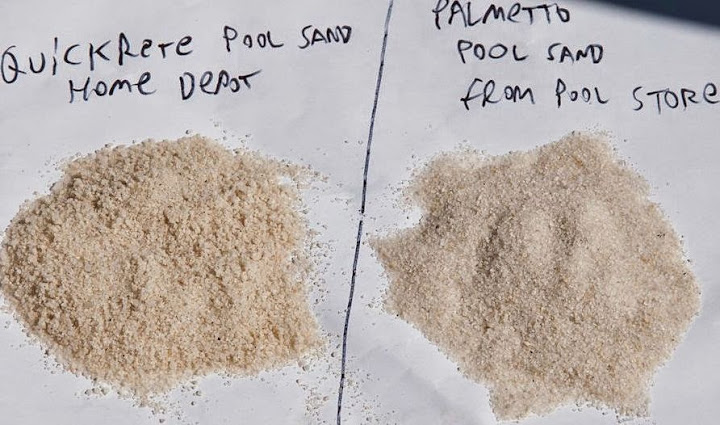
I ended up going to the pool store with a sample of the leftover sand I have, I definitely see a different in the consistency....I will post photos later. I'm a photographer, so that part is easy, lol. I decided to just change it, here it goes.
------------------------------------------------------
Bummer, I don't see a way to upload an image....the Quikrete definitely looked more coarse.
Last edited by PoolDoc; 05-03-2014 at 05:26 PM.
Re: Should I change my filter sand?
Last edited by PoolDoc; 05-03-2014 at 05:24 PM. Reason: edit pix
 Re: Should I change my filter sand?
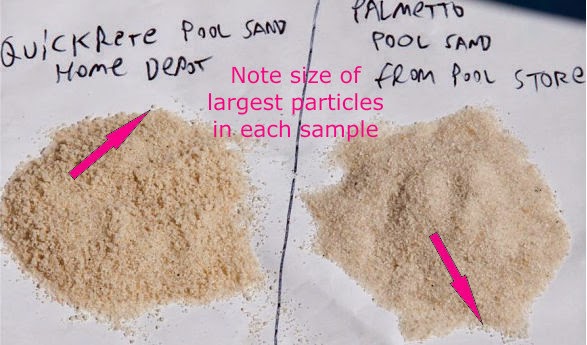
VERY helpful pictures.
But it looks like your mystery is solved: Quikrete was selling "pool sand", but they were bagging something else. Let us know how it goes with the new sand.
PoolDoc / Ben
Re: Should I change my filter sand?
Email sent, please share here if it helpsThanks, now hoping it clears water soon
======================================
from email:
Thank you. What main difference do you see? I thought sand is sand right, esecially if it says pol filter sand on the bag. To me it looks more coarse than the pool store sand I bought today. Wondering if that's why my last pump burned out.
Last edited by PoolDoc; 05-03-2014 at 08:11 PM.
Re: Should I change my filter sand?
Because the filter sand was still damp, it was a bit hard to compare. But what I noticed was that the largest visible particles in the Quikrete were larger than the largest particles in the than the Palmetto sand. Filter sand is *supposed* to be evenly graded, with 90+% of the particles ranging from 0.018" to 0.020". Honestly, neither sand appeared to meet that specification to me, but the Palmetto sand seemed a bit finer, and I know from experience that fine sand produces clearer water than coarse sand.
"Sand to be No. 20 standard silica (uniformity coefficient not greater than 1.75) .018-.020 in diameter particle size"
http://www.pentairpool.com/pdfs/TritonIIOM.pdf
"Grain size 20/40 mesh is most widely used. 90% of the sand is to fall within the specified particle range. Not more than 1% of the total sample
can fall on the first or last sieve in the series. Clay and silt size particles >105 microns are removed with the processing, as well as weak and crusted grains."
http://www.eqb.state.mn.us/documents...d%20report.pdf
Re: Should I change my filter sand?
No no, the samples were both un used, the Quickrete stuff was from inside the bag, leftover stuff I didn't use. Both bags had some condensation in them though, but this wasn;t sand that came from my filter.
 Posting Permissions
 Reply With Quote